Your seafood boil has arrived.
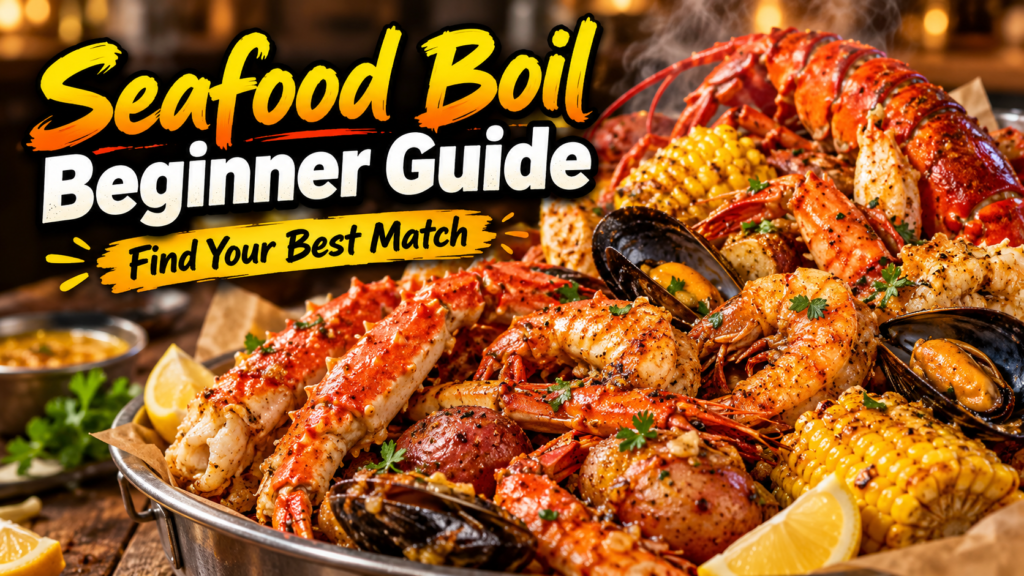
There is crab in front of you. Shrimp coated in sauce. Corn and potatoes sitting underneath everything. Someone at the table has already started cracking a shell with complete confidence.
You are looking at the crab leg wondering where exactly you are supposed to begin.
If that sounds familiar, you are not alone.
A seafood boil is one of those meals that looks completely obvious once you have eaten a few of them, but your first one can raise a surprising number of questions.
Do you use your hands?
Which part of the crab shell should you break?
Do you peel the shrimp before dipping it in sauce?
What do you do with mussel shells?
Are the potatoes just a side dish or are they supposed to soak up the sauce?
Is it normal for the table to become messy?
What should you order if you have never tried crab, lobster or crawfish before?
And perhaps the question nobody wants to ask once the food reaches the table:
How do you actually eat a seafood boil without looking completely lost?
The good news is that there is very little to get wrong.
A seafood boil is supposed to be hands-on. It is supposed to take time. Cracking shells, sharing food, trying different seafood and getting a little sauce on your fingers are part of the experience rather than mistakes to avoid.
This guide walks you through the entire process, from understanding what a seafood boil actually is to cracking crab legs, peeling shrimp, eating lobster, handling mussels and deciding what to order for your first visit.
If you have been searching for how to eat a seafood boil, this is where to start.
What Is a Seafood Boil?
A seafood boil is a meal built around shellfish and bold seasoning, usually served with simple sides that absorb the flavours of the boil.
Depending on the restaurant and the order, the seafood may include:
- snow crab;
- king crab;
- shrimp;
- lobster;
- crawfish;
- mussels;
- clams;
- or a combination of several types.
Common additions include:
- corn;
- potatoes;
- sausage;
- rice;
- garlic;
- lemon;
- and seasoned sauces.
The exact combination varies, but the experience is usually recognisable: plenty of seafood, strong flavour and a meal designed to be eaten slowly and shared.
A restaurant-style seafood boil is different from a traditionally plated seafood dinner.
Instead of receiving a neat fillet with a fork and knife, you are often working directly with shells.
That physical interaction is part of the appeal.
You crack.
Peel.
Pull.
Dip.
Share.
Then repeat.
It turns dinner into an activity rather than simply a plate of food.
Quick Answer: How Do You Eat a Seafood Boil?
If you want the short version, follow this order:
| Step | What to Do |
|---|---|
| 1 | Get comfortable and keep napkins nearby |
| 2 | Start with an easy item such as shrimp or mussels |
| 3 | Use your hands for most of the meal |
| 4 | Crack crab shells carefully at the joints |
| 5 | Pull the meat rather than crushing the entire shell |
| 6 | Dip seafood back into the sauce if you like |
| 7 | Use corn, potatoes or rice between bites |
| 8 | Keep empty shells separate from uneaten food |
| 9 | Take your time |
| 10 | Accept that the meal may get messy |
That is really it.
There is no complicated seafood-boil etiquette test waiting for you.
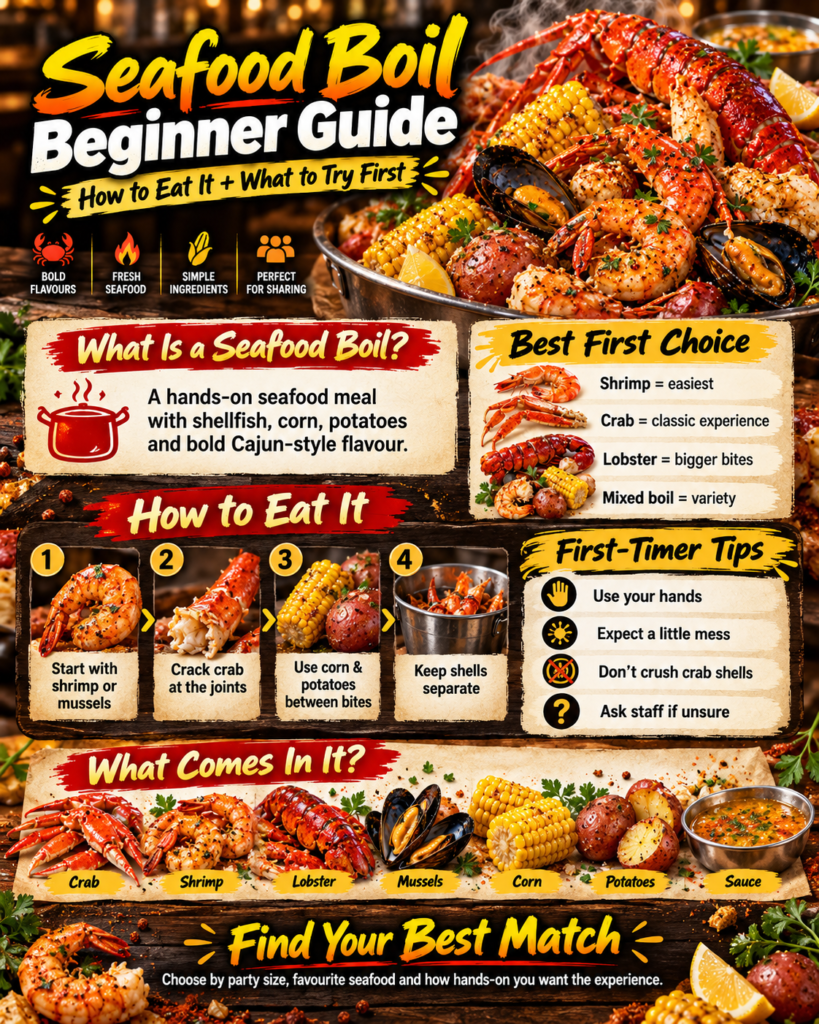
Do You Eat a Seafood Boil With Your Hands?
Mostly, yes.
That is one of the first things new customers notice.
Shellfish is naturally easier to handle with your fingers because you need to feel where shells separate.
Trying to cut a crab leg with a normal dinner knife is usually much more awkward than simply holding it.
Your hands allow you to:
- grip shells;
- twist shrimp;
- separate crab joints;
- open mussels;
- pull lobster meat;
- and control how much sauce you pick up.
Crab crackers or seafood picks can help with harder shells, but they support your hands rather than replace them.
If a restaurant provides gloves, you can use them.
Some people prefer gloves because of the sauce, while others prefer using clean bare hands because they have better grip.
There is no correct choice.
The goal is simply to enjoy the meal comfortably.
Your First Five Minutes at a Seafood Boil
The easiest way to avoid feeling overwhelmed is not to attack the largest crab cluster first.
Start simple.
Take a moment to look at what is actually on the table.
You might have:
- crab;
- shrimp;
- lobster;
- mussels;
- corn;
- potatoes;
- rice;
- sausage;
- and sauce.
Instead of thinking about the entire meal, choose one easy piece.
Shrimp is often a good starting point.
Mussels are another.
Once you understand how the sauce tastes and become comfortable using your hands, move on to crab or lobster.
A seafood boil gets easier after the first few bites.
What Should You Eat First?
There is no mandatory order, but some foods are easier to enjoy while they are hot.
A practical order for first-timers can be:
- mussels;
- shrimp;
- lobster;
- crab;
- corn and potatoes throughout the meal;
- rice near the middle or end to catch remaining sauce.
Why begin with mussels and shrimp?
They require very little work.
Crab is usually slower because you have to crack shells and extract the meat.
By leaving some crab for later, you can enjoy the meal rather than immediately turning dinner into a shell-removal challenge.
You do not need to follow this order exactly.
If crab is the entire reason you came, start with the crab.
How to Eat Shrimp in a Seafood Boil
Find Your Perfect Seafood Boil
Not sure what to order? Answer five quick questions and get a simple starting plan based on your seafood preferences, group size and the kind of experience you want.
Is this your first seafood boil?
We will adjust the recommendation to your experience level.
Who are you eating with?
Your group size can change the best way to approach the meal.
Which seafood sounds best?
Pick the seafood you are most interested in trying.
What type of experience do you want?
Choose the style of meal that sounds most enjoyable.
Where are you looking for a seafood boil?
We will use your area to personalise the next step.
What to start with
How to eat it
Your table strategy
First-timer tips
Find your seafood boil
New to seafood boils? Start here
A seafood boil is a hands-on seafood meal built around shellfish such as shrimp, crab, lobster, mussels or crawfish, together with seasoned sides such as corn and potatoes. If you are wondering how to eat a seafood boil, the simplest approach is to take one shellfish at a time and enjoy the meal slowly.
First-time diners often begin with shrimp or mussels because they require less shell work. Crab is a good choice when you want the classic shell-cracking experience, while a mixed selection works well when several people want to try different seafood.
If you are searching for a seafood boil near me, a Cajun seafood boil or a seafood restaurant in Ontario, use the location selector above to plan your visit and then check the restaurant’s current menu and location information.
This interactive guide provides general seafood-boil suggestions only. Menu availability and ingredients can differ by location. Always check the current restaurant menu before visiting or ordering. Customers with food allergies should contact the restaurant directly regarding ingredients and cross-contact. This tool intentionally does not provide or estimate prices.
Shrimp is one of the easiest introductions to a seafood boil.
Depending on your order, the shrimp may arrive headless or with more of the shell intact.
If the shell is present, hold the shrimp firmly and begin removing the shell from the underside, where it is usually easier to separate.
A Simple Shrimp Method
- Hold the shrimp with both hands.
- Remove the head first if it is attached.
- Use your thumb to loosen the shell.
- Peel the shell away from the body.
- Remove the tail shell if you want the whole piece free.
- Dip the shrimp into sauce or eat it as it is.
Do not rush.
Once you peel one or two shrimp, the movement becomes automatic.
Should You Peel All the Shrimp First?
You can, but there is no need.
Most people peel one, eat it and move to the next.
Peeling several shrimp in advance can make them cool faster.
Why Shrimp Is Good for First-Timers
Shrimp gives you the flavour of the boil without requiring much shell work.
If you are unsure whether you will enjoy the hands-on style of a seafood boil, shrimp is usually one of the easiest ways to begin.
How to Eat Snow Crab Legs
Crab legs look more intimidating than they actually are.
The key is not to crush everything.
You are trying to separate the shell while keeping the meat inside intact.
Step 1: Separate the Legs
Hold the crab cluster and gently twist individual legs away from the main joint.
Working one section at a time is easier than trying to manage the whole cluster.
Step 2: Bend at the Joint
Crab legs naturally have joints where sections meet.
Bend at those points rather than forcing the middle of a thick shell.
Often the shell begins to split naturally.
Step 3: Pull Slowly
Once the shell has opened, pull the sections apart gently.
If you are lucky, a long piece of crab meat will slide out almost whole.
Step 4: Use a Cracker When Needed
The thicker knuckle sections may not open easily with your hands.
This is where a seafood cracker becomes useful.
Apply enough pressure to break the shell, but avoid smashing it into many tiny pieces.
Step 5: Check the Shell
Before moving on, check whether any meat remains inside.
Some of the best pieces can hide inside thicker joints.
The Biggest Crab-Leg Mistake First-Timers Make
Crushing the shell too aggressively.
When you completely shatter a crab shell, small pieces can mix with the meat and make eating more difficult.
Think of the goal as opening the shell rather than destroying it.
A controlled crack is better than maximum force.
How to Eat Lobster in a Seafood Boil
Lobster can vary depending on how it is served.
Lobster tails are usually fairly straightforward.
If the shell is already split, you may be able to pull the meat out with minimal effort.
If it is intact:
- hold the tail firmly;
- separate or open the shell from the softer underside;
- loosen the meat carefully;
- pull it away from the shell;
- dip or coat it in sauce.
Lobster meat is thicker than shrimp and often becomes one of the more substantial bites in the meal.
This is one reason people choosing between crab and lobster often think about experience as much as flavour.
Crab gives you more shell cracking.
Lobster gives you larger pieces of meat with less repetitive work.
Neither is automatically better.
They create different meals.
How to Eat Mussels
Mussels may be the easiest shellfish on the table.
Most cooked mussels naturally open.
Hold the shell and remove the meat with your fingers or a small fork.
That is usually all you need to do.
If you find a shell that is unusually difficult to open, set it aside rather than forcing it.
Mussels also hold sauce well because of the shape of the shell, which is one reason they work well inside mixed seafood boils.
How to Eat Crawfish
Crawfish requires slightly more technique.
It is smaller than lobster but follows a similar basic idea: separate the tail from the body and access the meat inside the tail shell.
A simple beginner method is:
- hold the body in one hand and the tail in the other;
- twist gently to separate them;
- peel the shell away from the tail;
- pull out the tail meat.
Crawfish is one of the more hands-on choices, so it can be especially enjoyable once you are comfortable with the seafood-boil experience.
If this is your first-ever shellfish meal and you want the simplest option, shrimp may be easier.
If you specifically want the full cracking-and-peeling experience, crawfish is worth trying.
What Do You Do With the Corn?
Eat it.
This sounds obvious, but corn plays an important role in a seafood boil.
It absorbs seasoning and sauce while providing sweetness between richer seafood bites.
Instead of treating the corn as a side dish that you save until the end, try alternating:
crab → corn → shrimp → potato → crab.
The change in texture and flavour keeps a rich meal from becoming repetitive.
Why Potatoes Work So Well in a Seafood Boil
Potatoes absorb flavour extremely well.
They also help balance stronger sauce and spice.
If your seafood feels particularly rich, take a bite of potato before moving to the next piece.
First-timers sometimes ignore the potatoes because the crab or lobster looks more exciting.
Do not.
A sauce-coated potato can be one of the most satisfying parts of the meal.
What Is the Rice For?
Rice gives you another way to enjoy the sauce.
Once several pieces of seafood have been eaten, some sauce will usually remain.
Adding seafood or sauce to rice turns what might otherwise be left behind into another part of the meal.
This is especially useful if you like strong Cajun-style flavours but do not necessarily want every bite to be shellfish.
What Does a Seafood Boil Taste Like?
There is no single seafood-boil flavour.
The seafood itself changes the experience.
Shrimp is different from snow crab.
Snow crab is different from lobster.
Mussels bring another texture entirely.
The seasoning and sauce can change things even more.
A Cajun-style seafood boil usually aims for a bold flavour profile rather than lightly seasoned seafood.
Depending on the preparation, you may notice combinations of:
- garlic;
- butter;
- Cajun spices;
- pepper;
- herbs;
- citrus;
- savoury seasoning;
- and heat.
The seafood still matters, but the seasoning connects everything together.
That is why a shrimp, potato and piece of corn can all taste like they belong to the same meal.
Is a Cajun Seafood Boil Always Very Spicy?
No.
“Cajun” does not automatically mean painfully hot.
There is an important difference between spice meaning seasoning and spicy meaning heat.
A seafood boil can have deep, heavily seasoned flavour without becoming uncomfortable to eat.
If you are sensitive to heat, ask about the available spice or sauce options before ordering.
If you enjoy heat, you can choose accordingly.
The safest approach for first-timers is not to assume.
Ask.
Seafood Boil for Beginners: Which Seafood Should You Start With?
Here is a simple comparison.
| Seafood | Ease for Beginners | Experience |
|---|---|---|
| Shrimp | Very easy | Quick peeling, easy eating |
| Mussels | Very easy | Minimal shell work |
| Lobster tail | Easy–moderate | Larger premium pieces |
| Snow crab | Moderate | Classic cracking experience |
| Crawfish | Moderate | More peeling and hands-on work |
| King crab | Moderate | Large pieces, thicker shell |
If your main concern is:
“I don’t want to spend the whole meal fighting with shells,”
start with shrimp, mussels or lobster.
If your thought is:
“I came here specifically to crack crab legs,”
choose crab.
Crab vs Lobster vs Shrimp: Which Should a First-Timer Choose?
There is no universal winner.
Choose Shrimp If You Want Simplicity
Shrimp gives you:
- easy peeling;
- lots of individual bites;
- strong sauce coverage;
- less cracking.
It is probably the lowest-pressure first seafood boil.
Choose Snow Crab If You Want the Classic Experience
Snow crab is good if the shell-cracking ritual is part of what you want.
You will eat more slowly, but that is not necessarily a disadvantage.
For many people, cracking crab is part of what makes a seafood boil feel different from an ordinary seafood dinner.
Choose Lobster If You Want Larger Pieces
Lobster can be a good middle ground.
You still have a shellfish experience, but there is generally less repetitive cracking than with multiple crab legs.
Choose a Mix If You Are Curious
For a first visit with another person or a group, variety may make more sense than committing to one seafood.
Trying several types also helps you learn what you would order next time.
How Much Seafood Should You Order?
Start with the number of people eating.
This is more useful than immediately choosing your favourite seafood.
A solo diner has very different needs from a table of six.
One Person
A single seafood or smaller combination is usually easier.
There is no reason your first seafood boil needs to become a giant challenge.
Two People
Two people are in the ideal range for sharing.
A mixed combination can let both diners try several types of seafood.
Three or More People
Groups make variety easier.
Different people can prioritise different seafood without everyone needing a separate large order.
Crab Boil already has a detailed guide for choosing between crab, lobster and shrimp for one person, two people or a group.
Internal link here:
Crab, Lobster or Shrimp? What to Order at Crab Boil for 1, 2 or a Group
That page should handle the detailed ordering decision so this guide stays focused on the actual experience.
What Comes in a Seafood Boil?
There is no fixed universal combination, but a restaurant seafood boil may include several of the following.
Seafood
- shrimp;
- crab;
- lobster;
- mussels;
- crawfish;
- calamari or other seafood depending on the menu.
Sides
- corn;
- potatoes;
- rice;
- sausage;
- bread or other add-ons.
Sauce and Seasoning
This is what connects the different parts of the meal.
The same sauce touching crab, shrimp, corn and potatoes creates the shared flavour people associate with a seafood boil.
Is a Seafood Boil Supposed to Be Messy?
Yes.
Not deliberately chaotic.
But definitely more hands-on than most restaurant meals.
You are opening shells covered in seasoning.
Some sauce may get on your fingers.
Crab shells may not break perfectly every time.
You may need several napkins.
That does not mean you are doing it wrong.
Trying to keep a seafood boil completely tidy can actually make it more difficult.
The better strategy is simply to prepare for it.
What Should You Wear to a Seafood Boil?
You do not need special clothes.
But if you are worried about sauce, avoid wearing something you would panic about staining.
A few practical tips:
- roll long sleeves up;
- keep jewellery simple;
- tie long hair back if necessary;
- use the bib if one is provided;
- keep your phone away from the sauciest part of the table.
The goal is not to dress differently for dinner.
It is simply to stop worrying about your clothes once the food arrives.
What Do You Do With Empty Shells?
Keep them separate from the seafood you have not eaten.
If the table or restaurant provides an area for shells, use it.
Otherwise, create one clear space.
This sounds minor, but once several people are sharing crab and shrimp, an organised shell area makes the meal much easier.
You do not want to keep checking whether a crab leg is empty.
How Long Does It Take to Eat a Seafood Boil?
Usually longer than eating a standard plated meal.
That is normal.
Shellfish slows you down.
A seafood boil works best when you are not trying to finish dinner in fifteen minutes.
Give yourself time to:
- crack shells;
- talk;
- share;
- compare different seafood;
- and enjoy the sauce.
This is one reason seafood boils work particularly well for relaxed dinners with friends and family.
The meal itself becomes part of the entertainment.
Is a Seafood Boil Good for a Date?
It depends on the date.
If your idea of a good dinner is formal, extremely tidy and quiet, this may not be the obvious first choice.
If you want something casual, interactive and memorable, it can be great.
There is almost always something to talk about:
- which seafood is better;
- who cracked the crab leg properly;
- how spicy the sauce is;
- which combination should be ordered next.
A seafood boil removes some of the formality of a traditional dinner.
For some people, that is exactly the appeal.
Is a Seafood Boil Good for Families?
It can be, especially when the group likes seafood and sharing.
Parents should obviously consider individual preferences, shellfish allergies and whether younger children are comfortable with shells and spice.
The advantage of a larger seafood restaurant menu is that not everyone necessarily needs to order the same thing.
If one person is excited about snow crab and another prefers fried seafood or something simpler, check the full menu rather than assuming everyone must eat from the same boil.
Is a Seafood Boil Good for Groups?
Yes — group dining is one of the most natural ways to experience it.
A larger group can order more variety.
One person may prefer crab.
Another may prefer shrimp.
Someone else may want lobster.
A mixed table lets people try things without every person needing a separate full order.
It also turns the meal into a social experience.
Instead of everyone concentrating on individual plates, people are talking about the food in the middle of the table.
First-Time Seafood Boil Mistakes to Avoid
You do not need to become an expert, but a few small mistakes can make your first meal more difficult than necessary.
Mistake 1: Ordering Only by Price
Do not choose an expensive seafood just because you assume it must be better.
Choose according to what you actually enjoy.
If you love shrimp, a shrimp-focused order may be more satisfying than paying much more for crab you do not particularly enjoy.
Mistake 2: Ordering Too Much
Seafood-boil combinations can become substantial quickly.
Start with party size.
You can often add more food if necessary.
Mistake 3: Crushing Crab Shells
Crack enough to open.
Do not pulverise the shell.
Mistake 4: Ignoring the Sides
Corn, potato and rice exist for a reason.
Use them to break up rich seafood bites and enjoy the sauce.
Mistake 5: Being Afraid to Ask
If you do not know how to open something, ask.
Restaurant staff see first-time seafood-boil customers regularly.
Nobody expects every diner to arrive as a crab expert.
Mistake 6: Trying to Stay Perfectly Clean
Use napkins.
Use a bib.
Then concentrate on the food.
How to Choose a Seafood Boil Restaurant
If you are searching for a seafood boil near me, do not judge only by distance.
A few things are worth checking.
Menu Variety
Can you choose between several seafood options?
This matters especially for groups.
Clear Combinations
A good menu should help customers understand which orders work for individuals, couples and groups.
Sauce and Seasoning
The sauce is central to the experience.
Location-Specific Menu
Seafood supply and menu items can vary, so check the restaurant’s current menu rather than relying on an old photograph or third-party listing.
Non-Boil Options
This can be important for group dinners where not everyone wants shellfish.
Ordering Convenience
If you plan to order online, check the restaurant’s own location and ordering pages.
What to Expect on Your First Visit to Crab Boil
The easiest way to enjoy your first visit is not to arrive with a complicated plan.
Start with three questions.
1. How Many People Are Eating?
This immediately narrows the menu.
2. Which Seafood Do You Actually Like?
Crab?
Shrimp?
Lobster?
Or are you completely undecided?
3. Do You Want One Favourite or Several Different Seafood Types?
If you already know you love snow crab, focus on crab.
If you are curious, a mixed combination may make more sense.
Once you have answered those questions, ordering becomes much easier.
For the full decision guide, use the site’s Crab, Lobster or Shrimp? What to Order at Crab Boil for 1, 2 or a Group article.
Then come back to this guide when the food reaches the table.
A Simple First-Timer Ordering Strategy
If you have never had a seafood boil before, you do not need to order everything at once.
Try this framework.
| What You Want | Good Direction |
|---|---|
| Easiest first experience | Shrimp-focused boil |
| Hands-on classic experience | Snow crab |
| Larger premium pieces | Lobster |
| Maximum variety | Mixed seafood combination |
| Sharing with friends | Group combination |
| Not sure about shellfish | Smaller order + sides/non-boil item |
This is intentionally simple.
Your first seafood boil should help you learn what you like.
Your second order can become more specific.
Why Sauce Changes the Whole Experience
People sometimes think a seafood boil is mainly about choosing premium shellfish.
The seafood obviously matters.
But the sauce can influence your enjoyment just as much.
A good sauce coats:
- shrimp;
- crab;
- potatoes;
- corn;
- rice;
- and whatever else is part of the meal.
This creates consistency.
Instead of each ingredient feeling separate, the entire meal carries the same flavour direction.
That is why a potato can sometimes deliver almost as satisfying a bite as the seafood beside it.
Should You Dip the Seafood Back Into the Sauce?
If you want to, yes.
Some pieces will naturally carry more sauce than others.
Crab meat extracted from inside the shell may have less sauce on it than the outside shell.
Dipping the meat gives you more of the seasoning.
The same is true with lobster.
There is no rule saying every piece has to be heavily coated.
Taste first.
Then decide.
How to Make a Seafood Boil Easier for a Group
Group meals can become confusing if everyone begins reaching for the same things.
A few simple habits help.
Put Shells in One Area
This keeps the table organised.
Share Before Taking Seconds
If there are only a few crab clusters, make sure everyone who wants one has had a chance.
Order Around Preferences
If half the group loves shrimp but only one person wants lobster, do not design the entire order around lobster.
Add Enough Sides
Corn, potatoes, rice and other sides make sharing easier.
Consider Non-Boil Dishes
Not everybody has to eat the same meal.
Seafood Boil Etiquette: Is There Really Any?
Very little.
The basic rules are simply good shared-dining behaviour:
- do not take all of one premium item before others try it;
- keep empty shells out of the food;
- use serving utensils where provided;
- ask before using somebody else’s dipping sauce;
- and do not worry about eating slowly.
This is a relaxed meal.
You do not need formal dining etiquette.
What If You Have a Shellfish Allergy?
A seafood boil is a shellfish-heavy environment.
If you have a shellfish allergy or another serious food allergy, do not rely on assumptions about separate preparation.
Contact the restaurant directly before visiting or ordering.
Ask about:
- ingredients;
- cross-contact;
- preparation surfaces;
- sauces;
- fryers;
- and whether your requirements can safely be accommodated.
A blog article cannot determine whether a restaurant meal is safe for a specific allergy.
Direct confirmation is essential.
Seafood Boil vs Regular Seafood Dinner
The difference is partly food and partly experience.
| Seafood Boil | Traditional Plated Seafood |
|---|---|
| Hands-on | Usually fork and knife |
| Designed for sharing | Usually individual plate |
| Multiple shellfish options possible | Often one main protein |
| Sauce coats multiple ingredients | Sauce often served separately |
| Slower, interactive meal | More conventional dining |
| Shell cracking is part of experience | Seafood may arrive already prepared |
Neither format is automatically better.
They suit different occasions.
If you want a quiet plate of fish with minimal interaction, a boil may not be what you want.
If you want a lively seafood meal where everyone is involved, it makes much more sense.
Frequently Asked Questions
How do you eat a seafood boil?
Most seafood boils are eaten primarily with your hands. Peel shrimp, crack crab legs at the joints, remove lobster meat from the shell, open mussels and alternate the seafood with sides such as corn, potatoes or rice.
Do you eat seafood boil with your hands?
Yes. Hands are usually the easiest way to handle shellfish. Crab crackers or seafood picks can help with harder shells.
What should I eat first in a seafood boil?
There is no required order. For beginners, shrimp or mussels are easy starting points because they require less shell work. Crab can be saved for later when you are comfortable.
How do you eat crab legs at a seafood boil?
Separate individual legs, bend them at the natural joints and gently split the shell. Use a cracker for thicker sections and pull the meat out carefully instead of crushing the entire shell.
How do you eat shrimp in a seafood boil?
Remove the shell from the underside, peel it away from the body and remove the tail shell if desired. Then eat the shrimp as it is or dip it back into the sauce.
How do you eat lobster in a seafood boil?
Open the tail shell from the softer underside or existing split, loosen the meat and pull it from the shell. The meat can then be eaten directly or dipped into sauce.
What comes in a seafood boil?
Seafood boils can contain shrimp, crab, lobster, crawfish, mussels and other shellfish. Corn, potatoes, sausage and rice are also common additions.
Is a seafood boil spicy?
Not necessarily. Cajun-style seasoning can be bold without being extremely hot. Ask about the restaurant’s available seasoning or spice options.
Is a seafood boil messy?
It can be. Cracking shells and handling sauce with your hands naturally creates more mess than a plated dinner. Napkins, gloves and bibs can make things easier.
What should a beginner order at a seafood boil?
Shrimp is one of the easiest starting points. Snow crab is better if you specifically want the cracking experience, while a mixed seafood combination works well if you want to sample several types.
Is crab or lobster better for a seafood boil?
Neither is automatically better. Crab offers more shell cracking and smaller pieces, while lobster typically provides larger pieces of meat with less repetitive cracking.
Is a seafood boil good for two people?
Yes. Two people can share a combination and try more than one type of seafood without needing a large group order.
Are seafood boils good for groups?
Yes. Group dining makes it easier to order different seafood and share several dishes.
What do you do with the potatoes in a seafood boil?
Eat them between seafood bites. Potatoes absorb seasoning and sauce well and help balance richer seafood.
Why is corn included in seafood boils?
Corn adds sweetness and also holds sauce and seasoning well.
What is Cajun seafood boil?
A Cajun-style seafood boil combines shellfish and sides with bold, savoury seasoning and often a rich sauce. The exact seafood and seasoning can vary by restaurant.
Can someone who does not like crab still enjoy a seafood boil restaurant?
Usually, yes. Seafood boil menus may include shrimp, lobster, mussels, crawfish and other dishes. Check the current restaurant menu for specific alternatives.
Where can I try a seafood boil?
If you are ready to move from reading about seafood boils to trying one, use the Crab Boil Locations page to find the restaurant closest to you and check the current location-specific menu before visiting.
Final Thoughts: Your First Seafood Boil Is Supposed to Be Fun
The biggest mistake a first-timer can make is worrying too much about doing everything correctly.
There is no perfect way to crack every crab leg.
You may break one badly.
A shrimp shell may take longer than expected.
Sauce may end up on your hands.
You might discover halfway through the meal that you prefer shrimp to crab.
That is part of the experience.
A seafood boil works because dinner becomes interactive.
Instead of receiving a plate that looks exactly the same from the first bite to the last, you work through different seafood, textures and flavours.
You crack something.
You taste it.
You dip it in sauce.
You try the corn.
Someone across the table tells you to try the lobster.
You decide the potatoes are unexpectedly good.
Then you finally understand why people enjoy eating seafood this way.
So if you are trying your first seafood boil, do not worry about looking like an expert.
Start with one piece.
Use your hands.
Take your time.
And enjoy the mess.
Ready to try it for yourself? Explore the Crab Boil menu, choose your seafood, and visit the Locations page to find the restaurant nearest you.